Tuesday, February 12, 2013

An Interview with Susan J. Laidlaw, Author of AN INFIDEL IN PARADISE


All of us at MiG Writer's are so excited because Susan Laidlaw's YA novel, AN INFIDEL IN PARADISE (published by Tundra Books) is out today!
It's available from Tundra Books  and the usual places such as Amazon, Barnes & Noble and Chapters-Indigo.
I interviewed Susan about her writing and some of the challenges she experienced when writing the book:

Share a little about how you ended up as a writer.

I've wanted to be a writer since I was a child. I actually studied journalism for a year but switched to English when I realized I wanted to write fiction. When I graduated, I took off to Africa as a volunteer teacher. I discovered I loved teaching but more than that I discovered I loved talking to kids and helping them with their problems, so after three years I returned to Canada and did a Masters in Clinical Social Work. I've been an adolescent counselor ever since but I continued to write, mostly for my own pleasure, but occasionally for professional purposes.

I was working at a counseling center in Taiwan and writing articles on parenting when a colleague approached me and said he'd read my articles and wondered if I'd ever thought of writing fiction. While my articles were non-fiction, they were quite humorous and I guess that's what appealed to him. In any case, he'd formed an SCBWI critique group and he wanted me to join. I wrote the first chapter of AN INFIDEL IN PARADISE in preparation for that group.

How did the idea for your story emerge?

I've lived overseas in Asia, Africa and Europe for twenty-two years, so most of the kids I've counseled are like the protagonist in my book. Due to the nature of their parents' jobs, they change countries frequently. By the time they hit their teen years, which is usually when I meet them, they may have lived in a half a dozen different countries and spent very little time in their "home" country.

Some kids find moving around a rewarding and enriching experience but many find leaving friends behind, and having to start over every couple of years, painful and stressful. Obviously, the ones who have more difficulty making the transitions are the ones I see in counseling. The constant moves prevent them from developing a strong support network of friends or extended family. They've often spent little time in the "home country," so they don't have a strong sense of connectedness with their homeland either. This lack of a consistency in friendship, family and culture can cause problems in their identity formation.

Identity, as you know, develops throughout childhood, and is our shared sense of values and beliefs that inform the way we relate to, and behave in, the world. Identity is created through our interactions with those around us, so we usually have a sense of belonging with those who have grown up around us, through shared beliefs, values, and ways of behaving. This forms the basis of our "national identity," though it's not limited to national identity and may include our religion, our ethnicity, or other influences that have been strong and consistent throughout our childhood.

Kids, like those I've worked with and the protagonist in my book, may not have this sense of identity because they've had no consistency of shared values and beliefs with those around them. The only constant in their lives is their nuclear family but they often feel alienated from their own parents since they don't share their parents'"national identity," any more than they share the identity of people in the country they happen to be living in at any one time.


Both of my sons grew up overseas and are examples of this phenomenon. My eldest will tell you he's Asian, though he's a green-eyed blonde. My youngest is a chameleon. He'll take on the identity of those around him. Chameleons are very common in the international lifestyle and often the most successful at transitioning from one culture to another, but even when surrounded by friends, they may still feel profoundly isolated because looking and acting like everyone else isn't the same as actually feeling connected.

One of the things rotational kids find particularly hurtful is the inability of those around them to understand how difficult it is to keep starting over and to never feel at home anywhere. Home country peers, teachers, sometimes even their own parents, will just tell them to stop whining. But the depression, alienation and anger that these children feel is a well-documented result of their rotational lifestyle. Psychologists, like David Pollock, Ruth Van Reken and Ruth Hill Useem, to name just a few, have been studying and documenting these psychological ramifications for more than fifty years.


What was the most challenging aspect of writing your book?

The hardest thing about writing this book was to make Emma, a rotational kid, comprehensible to people who haven't had her experience of moving around. Emma's an angry, alienated and depressed kid, in the throes of culture shock. But just like the hundreds of kids I've worked with, she's going to confront people who don't have the ability to empathize with her situation.

Rotational kids become very good at faking it with those who don't share their nomadic existence. They know they're not going to be understood, so they learn not to talk about themselves. I wanted to break down this barrier and hopefully make it a little easier for these kids to talk about what they're going through. At a minimum, I want them to be able to read a book that reflects their life experience.

I don't think feeling like an outsider is unique to rotational kids though. I know a lot of young people feel this way and I hope they'll identify with Emma, despite the differences in lifestyles. Rotational kids don't have a monopoly on challenging childhoods. Kids can suffer so many traumas, like bullying, family breakdown, death of a loved one, peer pressure. I don't think a reader needs to have experienced Emma's life to identify with her pain. They only need to be capable of empathy and most teens have plenty of that.


Each book I write teaches me something about the world, myself or the process of writing. What did you learn through writing your book?

I think what I learned most from this experience is how weird my life experience is. I've lived in a bit of a bubble overseas. Most of the people I know move around like I do. As hard as it sometimes is to explain the anger of a rotational child to her own parents, it's a million times harder to explain it to someone who's never experienced culture shock, or left behind cherished friends, or longed for a sense of connectedness to someone or something.

I went overseas when I was twenty-one. I lived in a tiny village, in a very Islamic part of Northern Nigeria. I had no electricity, no phone, no way to connect with family and friends back home. I think perhaps that experience changed me in a fundamental way that I didn't entirely understand until I wrote this book, but when a kid comes into my office, angry or depressed because her parents have moved her yet again, I feel an immediate connection that transcends my usual empathetic response to an unhappy kid. As much as I love moving around, and despite the fact that I willfully subjected my own children to this lifestyle, I feel that child's pain with every fibre of my being. But can I communicate that to a reader in a meaningful way? There's the challenge.


Because I love reading as much as I love to write, I'm always curious about what other people like to read. Do you have any favourite books?

I love anything by Rohinton Mistry. A FINE BALANCE is my favourite contemporary novel. BEHIND THE BEAUTIFUL FOREVERS by Katherine Boo is my favourite non-fiction. Beyond that, I have so many writers I love it would be unfair to mention any of them.

Do you have anything else you'd like to tell us about writing your book or about your next project?

One thing I've been asked a lot is how much of Emma's story is true. The short answer is that the majority of the story actually happened in one way or another. I've talked a lot about how Emma is based on a lot of kids I've worked with over the years, so you've probably already caught on that I'm not really a very imaginative person.
I also lived in Islamabad, the setting of AN INFIDEL IN PARADISE, for two years. I lived on the Canadian Compound, where Emma lives. It was much as I described it and yes, we really did get cobras in the yard and the guards really did shoot them. Children did pick through garbage behind our compound. I came across them, as Emma did and responded in much the same way.
The bombings and evacuations in the story happened while we lived there. I changed the timeline but not the details. The frequent demonstrations and the way they were dealt with at the school is also factual.
Even some of the conversations Emma had in the story were based on ones I had myself with Pakistani friends. Her trip to the market, for example, mirrored my own.
I don't know if I got all the details right but my eldest said recently that for him, reading the story felt like "going home." From a kid who rarely knows where "home" is, this felt like high praise, and maybe that's enough.
For more about Susan, please visit her website at www.susanjlaidlaw.com.

You can also read more about Susan's writing process and her book in an interview with Debbie Ridpath Ohi, Interview With YA Author S.J. Laidlaw About Process, Persistence and AN INFIDEL IN PARADISE.


-- Andrea Mack

Wednesday, February 6, 2013

SCBWI NY Conference Recap


This past weekend all of us MiGs met up at the SCBWI conference in New York. It was an amazing time because this was the first time all six of us met together at one time.

We had a blast attending the conference sessions together.


Hanging out at the cocktail.


Gossiping in the hotel room.


Having fun talking about books.


And taking lots of pictures!


We created a video recaping our time in New York to remember all the fun times we had together. Check it out!


Wednesday, January 30, 2013

Questions A Writer Should Know How to Answer

As I prepare for my first ever big writing conference (SCBWI New York), I'm trying to calm my nerves by thinking about how to answer some questions that might come up in casual conversation. But it occurred to me that I often get asked these questions by non-writers, too. Every once in a while, it’s not a bad idea to take a minute to think about how you’d answer these questions, and even practice them, so you don’t become all tongue-tied if the occasion comes up.

1. What do you write?

2. How did you become a writer/get started writing?

3. What are you working on now?

4. Have you ever been published or where can I find your books?

Of course, you need to keep in mind who’s asking. Some of the writing lingo we use as writers may not be familiar to non-writers. I recently had a conversation where I ended up explaining the term “dystopian” in a hallway of my school. (Lucky for me, I can now refer to the TV series Revolution). And I’m often asked to explain what “middle grade” means – not to be confused with “middle school”, which doesn’t necessarily capture the same age group. There’s also the difference between YA and MG (see MG vs YA: What's the Difference by MiG Writer Debbie Ridpath Ohi for clarification), which isn’t always as clear cut as we’d like to think.

Of course, at SCBWI, everyone will know these distinctions, which will make conversations and explanations that much easier. I can concentrate on what I want people to know about me and my writing. (Because even though I’m an introvert, I do want people to read and know about my work.) It will also be useful to remember that I can draw on these questions when I’m trying to think of what to say to other writers that I meet (since I’m sure they’ll know the answers and feel comfortable talking a little about their work), along with these:

5. Have you been to one of these conferences before?

6. Do you have any tips for a newbie?*

Painful as it may be for someone who spends a lot of time on the computer, it's important to be able to articulate something sensible about what I'm actually doing for all those hours (so I'd better not mention all the time I spend reading blogs and, lately, tweets.) Can you think of any other questions a writer needs to be able to answer?

*For more tips on calming your nerves before attending a big conference, check out Debbie Ridpath Ohi’s comics for conference newbies.

-- Andrea


Wednesday, January 23, 2013


Dear Readers,

I ran out to get the newspaper yesterday and found a package on my doorstep. I’m not sure how it got there - my dogs have poor manners when it comes to someone walking up to our house. (Ax murderer, UPS guy - eh? It’s all the same to them. Bark! Bark! Bark!) 

I wasn’t expecting anything so I eagerly scooped it up and brought inside. It was from my new publisher, Holiday House - a book on the house’s first sixty-five year history. Tucked inside, there was a dated, handwritten note:

Dear Carmella,

Welcome to Holiday House - and thank you for being a part of this story.

It was signed John Briggs.*

Wow. How cool was that?

I guess I never really thought about myself as being a part of something bigger, part of someone else’s story and history. It was a neat feeling and an unexpected surprise. **

Later in the afternoon, I got to thinking about it. You know, if we write for children and teens aren’t we ALL part of something special and bigger than ourselves? Most of us will never make the New York Times Best Sellers list or win an award. Shoot. Some of us may never be published. (Or be published again.) But that’s okay. We’ve got one of the greatest callings in the world. To inspired, teach, reach, comfort, delight, and challenge young readers. 

So in case no one has told you this lately, thank you for being part of the story. Thank you for writing the books and poems and songs and for illustrating those stories that help make the world better and brighter. 

Best,
Carmella 

* He’s the current owner and president of Holiday House.
** I don’t mean to in any way suggest that my other publishers haven’t been awesome. Because they totally have. They show me love in different ways and I thoroughly enjoy being a part of their stories, too.  

Wednesday, January 16, 2013

MiG Writers: Meeting In Person For The First Time At The SCBWI Winter Conference


Only a couple of weeks left until the SCBWI Winter Conference in NYC! I'm so looking forward to the event, not just because of the amazing faculty line-up and programming, but also because it will be the first time that all members of our MiG Writer group meet in person!


I've met Andrea Mack and Carmella Van Vleet once before and look forward to seeing them again, but I haven't yet met Christina Farley, Kate Fall or Susan Laidlaw in person.

(Click image for bigger version)

I started attending SCBWI conventions regularly in 2009. I was so nervous about not knowing anyone there, and about having to go up and introduce myself to strangers. I'm an introvert at heart (I suspect many creative types are), so I decided to do some prep ahead of time to make things easier at the event.

(Click image for bigger version)
This prep included:

1. Networking online ahead of time on the SCBWI message boards and other social media. I didn't hide the fact that I was a nervous newbie.

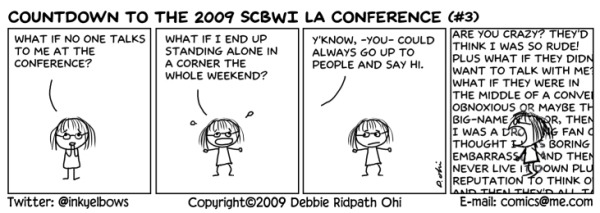
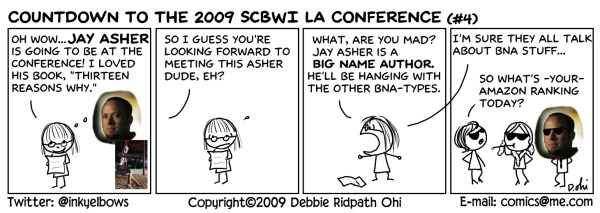
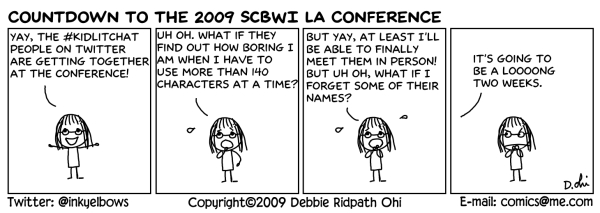
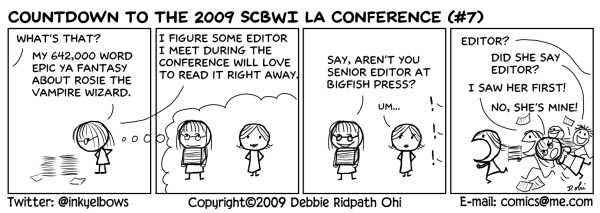
2. Doing some comics about being nervous.

(Click image for bigger version)

Turns out I wasn't the only nervous newbie! Plus the veterans were generous in offering advice on how make the conference more enjoyable. I also made plans ahead of time to get together with others:

(Click image for bigger version)

But not TOO many plans! I wanted to leave flexibility for hanging out with people I had met at the conference.

(Click image for bigger version)

I also read over posts people had written about conference etiquette and tips on how to meet (and how NOT to meet) others in the industry. But the most important piece of advice, I found, was to HAVE REALISTIC EXPECTATIONS:

(Click image for bigger version)

Also: to have a clear idea of what my goals were for the conference. And again, make those goals realistic. 

One of my goals for this conference coming up: To meet the other MiG Writers in person.

Can't wait. :-)

p.s. If you'd like to see all my SCBWI Newbie Comics, see this blog post.

-------
Debbie Ridpath Ohi writes and illustrates for young people. She illustrated I'M BORED by Michael Ian Black (Simon & Schuster Books For Young Readers), which was chosen as a New York Times Notable Children's Book Of 2012. Debbie is currently working on two more books for S&S. Blog: Inkygirl.com. Twitter: @inkyelbows.

Saturday, January 12, 2013

Congrats to Carmella on the sale of her MG novel, ELIZA BING IS (NOT) A BIG FAT QUITTER, to Holiday House!


We at MiG Writers are thrilled to announce that Carmella Van Vleet's debut middle grade novel, ELIZA BING IS (NOT) A BIG FAT QUITTER, has sold to Holiday House!

Congrats to Carmella and her agent Marie Lamba (The Jennifer DeChiara Literary Agency) on this news. You can find out more about Carmella and her work at her website.

Wednesday, January 9, 2013

My Life is Like a YA Novel


More specifically my life is like my YA  novel. Does that really surprise you? Aren’t we all just writing about ourselves under a thinly veiled guise of creative inspiration? You can’t tell me that J.K. Rowlings isn’t half witch the way she makes money appear.


So, back to my point, in my YA novel, my main character Emma moves to Pakistan. It’s a radical change from her former home in the Philippines. In the past three months I have moved to SocialMediaLand. It’s a radical change from my former home, which was my former home – four walls, a roof, familiar faces, you get the drift. 


In the Philippines, Emma has lots of friends, fun activities, the freedom to go where she wants, and a warm and hospitable culture. In Pakistan no one knows her, though a few kind girls try to help her fit in. The culture itself is at times hostile, even threatening, and her freedom of movement is severely curtailed. 


This is totally me!


In my own home, I’m very popular. My husband likes me, my kids like me, my 3lb. Yorkie thinks I’m the best thing since sliced chicken. And I am competent and have enormous freedom. I know how to operate all the machinery, the dishwasher, the coffee maker. I can even hop in the car and go exactly where I want, when I want.


In SocialMedialand I’m very unpopular. I’m not joking! I am wildly, demonstrably, and honestly kind of amusingly unpopular. Do you want proof? There are 166 YA books listed on Goodreads as coming out in 2013. My book, AN INFIDEL IN PARADISE, is the 166th on the list of books people want to read. So among the thousands of Goodread readers, I am the last person anyone wants to meet.  If that’s not a hostile environment, I don’t know what is. If I showed up at Goodreads High School, I would definitely be eating alone in the lunch room.


Another incontrovertible parallel, and the main reason I’ve been so reluctant to move to SocialMediaLand, is I that don’t know how to operate anything and it takes me forever to get anywhere, if I get there at all. My blog for example http://www.sjlaidlaw.com/blog/ has no pictures, not because I  have no pictures but because I can’t figure out how to upload them. I didn’t even have a website for the longest time because just the thought of creating and navigating one put me into a cold sweat. I tried and failed to create an author’s page on Goodreads, though in light of my recent rating over there, this example is looking a lot less random. In any case, this is just the tip of the iceberg, believe me.


But, like Emma, I have not been totally abandoned in SocialMediaWasteLand. On the first day of school Emma is befriended by a group of girls who do their best to help her fit in. Gradually, she makes more friends and amid the hostility of those who don’t really know her, she discovers a home with the few who take the time to. My MiG partners are my first-day-of-school girls. They’ve been with me almost since the beginning of my writing journey and do their best to explain the rules of SocialMediaLand, though I still maintain the rules defy explanation.  Gradually, I’m making more friends in SocialMediaLand  – shout out to @TheLucky13s and of course the talented, supportive team at @TundraBooks


But I’m still 166th of 166 at Goodreads. Does that mean I’ll be eating alone at the lunch table? I guess on Feb. 12th when AN INFIDEL IN PARADISE arrives in stores, we’ll all find out. But whatever happens my Yorkie still thinks I’m amazing.