Thursday, July 5, 2012

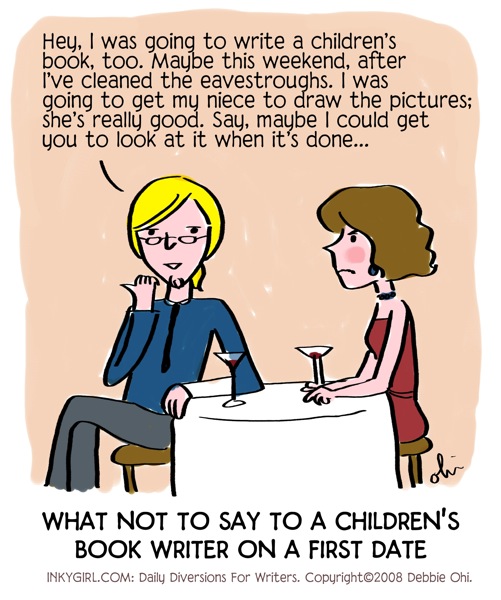
Comic: What Not To Say To A Children's Book Writer On A First Date

OHI0139 KidsBookWeekend

I'm posting some of my older comics here as I catalog and tag them in prep for a print book compilation. You can find my comics for writers on Inkygirl (http://inkygirl.com), Tumblr (http://inkygirl.tumblr.com) and Pinterest (http://pinterest.com/inkyelbows/comics-for-writers-inkygirl-com)

Friday, June 29, 2012

The Challenges of Making Characters Come Alive

A secondary character can be a trusty sidekick. Or the quiet, mouse-like kid that needs protection. Or the bossy, bullying one that always seems to be listening in on the heroine’s plans. My secondary characters always seem to be full of personality. So much that they often threaten to steal the scenes away from my main character. And there’s my problem. Why is it that the main character is so much harder to bring to life than a secondary character?

You can start thinking about the main and secondary characters in the same way. They have strengths and flaws, personality traits, physical appearance, etc. But there’s a lot more pressure on a writer to create an engaging main character.

While the main character has to change and grow throughout the story, the secondary characters can just hang out and have fun, appear when they’re needed and disappear when their bit is over.

In a compelling story, the main character cares about something so much he or she will do anything to have it, and writer has to convince the reader that the wanting it is worth it. Secondary characters can care about it too, but it’s not like their world will end if they don’t have it.

One of the strategies for writing a compelling main character is to try to put yourself in the main character’s shoes. Oddly, what this helps me with is bringing to life my secondary characters. In real life, I’m always making observations about other people—their mannerisms, their emotions, their choices. When I create secondary characters, these details emerge naturally in my writing.

But when I’m standing in the main character’s shoes, I have to turn that same lens on myself. Analyze my own (or my main character’s) strengths and weaknesses. It’s so much harder. Especially since that main character is not quite me, but some made up version that is part me/part the-heroine-I’d-like-to-be/part the-person-whose-flaws-create-the-most-conflict.

The part that is me doesn’t really like probing into the sensitive stuff that I’d normally cover up so I don’t have to deal with it. The heroine part wants to…well, be a hero. She doesn’t want to think about her flaws and bad choices. And the flawed part of the character would rather not remind anyone of her shortcomings, even if they do help to create a good story.

All this makes it so difficult for me to create a main character that really comes alive for the reader.

What do you think is your biggest challenge in breathing life into your main character? Do you find it harder to create your main character or your secondary characters?

Friday, June 22, 2012

Breaking through the wall


Yesterday I got my sixth tattoo. It was a coverup up of something I wasn’t happy with and didn’t really fit my personality anymore. I waited a long time to have it done and saved for months to afford it. It’s the biggest one I have and so - no surprise - it took the longest time to get done.
For the first two hours or so, I did okay. The pain was manageable and I was able to talk my way through it. (My daughter and friend came along for support and to engage in mindless conversation with me.) But by the time we got to that last hour-and-a-half, I was in significant pain. I was genuinely worried I might throw up and instead of being chatty, in my mind I was screaming, “Are we done yet?! Please be done!” 
I get the same way when I reach that three-quarters the way through point when I’m writing a book. I move along fairly well and then, suddenly, it Gets. So. Hard. and it seems like it’ll never end. I’ve heard the same thing happens to people who run marathons. (I wouldn’t know because they only time I run is when people are chasing me. Which is to say, rarely.) 
That wall is a tough thing to break through. Like with my tattoo, I usually just grit my teeth, try not to scream out obscenities and concentrate on the end result. 
What about you? How do you push through that wall? How do you find your second wind?

Tuesday, June 19, 2012

Pixar's Rules of Storytelling

There is a graphic representation of Pixar's Rules of Storytelling going around "teh Intertubes," courtesy of Beau Chavassus, which I will insert here and hope you can enlarge it. These supposed rules were created for screenplay writing, but I think some of them are immensely important for novel writing. My alter ego (no, actually just me, editing as www.fallingforwords.com) reads manuscript submissions for Rhemalda Publishing. I can tell you which rules took me years to understand, and now  as a reader bother me the most. I can sum up rules 1, 4, 6, 13, 16, and especially 21 with one phrase: I have to care about what happens to your main character before you put him or her in mortal danger.

Writers are often told to start with action. This is early writing advice, to get you past beginnings on the first day of school, as someone wakes up, staring into a mirror, recounting family history, etc. But  you can't swing too far on the pendulum. Start me off with a plane crash where only your main character survives, and I'll mourn the dead. Start me off with your main character's actual life (with movement toward goals, which may be a better term than action) and then I might care more about him or her than the other passengers on the plane.

I would say don't start with Michael Bay, exploding things action (unless you're writing Transformers 7). Start with forward momentum. Start with building tension. Start with Harry Potter trying to get out of the cupboard under the stairs, Mrs. Frisbee feeling her son's forehead for fever, the rabbits in Watership Down staring at a man-made sign and wondering what it foretells. Then move to Hagrid's Apparition, Mrs. Frisbee's desperate appeal to Rats of NIMH, and the bulldozers destroying the rabbit warrens. Analyze the beginnings of your favorite novels and movies. There's a very good reason FINDING NEMO doesn't open with Nemo's disappearance.


I'm not sure if these are actually Pixar's rules, but they're great guidelines anyway. Once upon a time, _____. Every day, _____. Then one day, _____. Don't skip the "Every day" part. As I've heard it phrased before, tell me what makes your main character different from everyone else. That's the first question that should be answered, in my opinion. 

-- Kate

Wednesday, June 13, 2012

Making Clay

I hate first drafts. HATE them! They are slow and torturous and overwhelming. But today, as I was staring at the screen waiting for inspiration writing, I got to thinking about an exercise I sometimes do with students when I’m talking about revision. 
The first thing I do with the kids is hand each of them a small ball of Play-doh™ (or similar modeling clay). Then I ask them to spend a few minutes creating whatever they’d like. Depending on the age of the kids, I usually get plenty of snakes, bowls, snowmen and the like. Once everyone is happy with their work, I ask them to roll the dough back up into a ball and make something else. Most of the time, I get groans and protests. “But I like what I made!”
They usually comply, though, and end up happily rolling and pinching and creating. Then I explain that this is what revision is - just playing with what you’ve already got. Maybe you make something altogether new or maybe you just make something better. On a good day, I get plenty of “Aha!” moments. It’s awesome.
I love revision. But here’s the problem though - you can’t revise without “something” to work with. So I’ve decided to start thinking of first drafts as nothing more than making clay.
Since I’ve written a bunch of craft books, I know a thing or two about making clay. Mixing up clay can be consuming and not always an exact science. (Especially if you’re making up a new recipe!) Sometimes you add a little of this but then find you need a little more of that. You get gunk all over your work space and yourself. And Heaven help you if you have an itch or the phone rings!


But isn’t it also wonderful to put your hands in the bowl and get them all dirty and squish the wet stuff between your fingers? And isn’t it fun to think about all the things you’re going to make? Or commiserate with someone nearby while the two of you are both elbow deep in a mess? Isn’t it satisfying when you look down and realize that the clay is perfect and ready for molding? And that while your hands are tired, it’s a good kind of tired? Isn't it awesome to share your clay with friends?
Yeah. All that stuff is pretty darn cool, too. 
So tomorrow when I open the file on my WIP, I won’t be writing a first draft: I’ll be making some clay.

Thursday, May 31, 2012

Comic: Critiquing Rule #1 (& Tips On Finding The Right Critique Group)

One of the reasons I felt so lucky when the MiG Writers' group let me join: I never had to go through the above scenario. :-)

To those still looking for a critique group: make sure you find a group in which members are at the same or (preferably) higher level of writing experience. If you find yourself feeling as if you're not getting as much from the group as you're giving, then it's time to move on.

For those who are wondering, I found out about the MiG Writers when they posted on the SCBWI message boards saying they were looking for one more member. Here's the link to the Critique Groups forum, but you need to be an SCWI member to access it.

Before you join a critique group, try to find out as much as you can about the group and its members. The more experienced groups usually will do the same, asking questions to make sure you're the right fit within the group.

Some questions to ask about the group:

How old is the group? More experienced groups have had time to settle into a rhythm and system that works for everyone.

How experienced are its members? How much writing experience? How much publication experience, if any?

What types of writing are acceptable for critique? If at all possible, join a group that focuses on your writing interest. If it's a group that critiques multiple age groups and genres, then be prepared to do a wide range of critiquing in genres you may not be familiar with.

What are the rules for critiquing? How often are members expected to submit material for critiques (and how many words/pages)? How often are you required to critique? What if you need to take some time off (e.g. vacation or other personal commitments)?

After trying out several critique groups, I finally found the PERFECT GROUP, at least for me: the MiG Writers. I learn as much or more from critiquing as I do being critiqued.

Thank you, MiG Writers! :-)

Tuesday, May 29, 2012

Hanging Out with Debbie Ohi on Google +


Yesterday Debbie Ridpath Ohi and I "met" on Google + hangout. We've known each other for many years via online so it was so wild to see her live and hear her voice. After we squealed in shock, it was natural just to dive right in and start chatting. I realized that sometimes email just doesn't cut it like actual talking does.

I've never done anything like chat via video before so it was my first time trying out my web cam. And now I'm addicted!

It's very simple to set up, especially if you already have a Google account. Go into your account and click on the hangout icon on the left. Create a hangout and then choose who you want to hangout with. And there! You're ready to chat. It's that easy.

Debbie and I said we needed to get all the MiGs on there once in a while and have group chats. If you have an online crit group or are planning an event with multiple authors, it's really the way to go.

We chatted about writing, marketing and ideas we have for new projects. I really value her advice and I was taking notes. We even talked about my little secret (okay, so it's kind of a BIG secret) that I hope to be able to tell you all about soon.

Here's the very cool picture that Debbie created after our talk. Isn't she so talented?


~Christina